Skip to content

November 2026#

How to choose a video codec for video conferencing
How to choose a video codec for video conferencing: AV1, VP9, H.264 and VP8 each win in a different room, and the right pick depends on your users' devices and network

Picking the codec that compresses best and eats the least bandwidth looks, at first glance, like the obvious call when you build a video conferencing application. And yet the codec that saves the most bandwidth can be the one that performs worst for your users.

The reason is that compression efficiency is only part of the problem. Choosing a codec also depends on device compatibility, hardware encoding support, available CPU, battery drain and the quality you end up with. And most importantly: no codec wins on all of those fronts.

How Eventials cut live streaming incidents by 90% with OpenVidu

Eventials and OpenVidu customer success story Eventials and OpenVidu customer success story

Sometimes, companies face challenges for which they envision a solution that doesn't exist. Eventials is one of them. When tackling 30,000+ viewer live streams, the team needed an infrastructure that could scale, while at the same time kept the costs low and under control, all of them without breaking their sanity.

We talked to Henrique Otsuka, Head of Information Technology at Eventials, about how they produce those broadcasts on OpenVidu: what they tried before, why he led the move to OpenVidu 3, and how separating interaction from distribution lets them scale. For 13 years Eventials has run webinars, white-label corporate learning platforms and professional live streaming production for organizations across Latin America, being the largest webinar platform in Brazil.

ARM or x86 for WebRTC media servers? Participants per node on 3 clouds

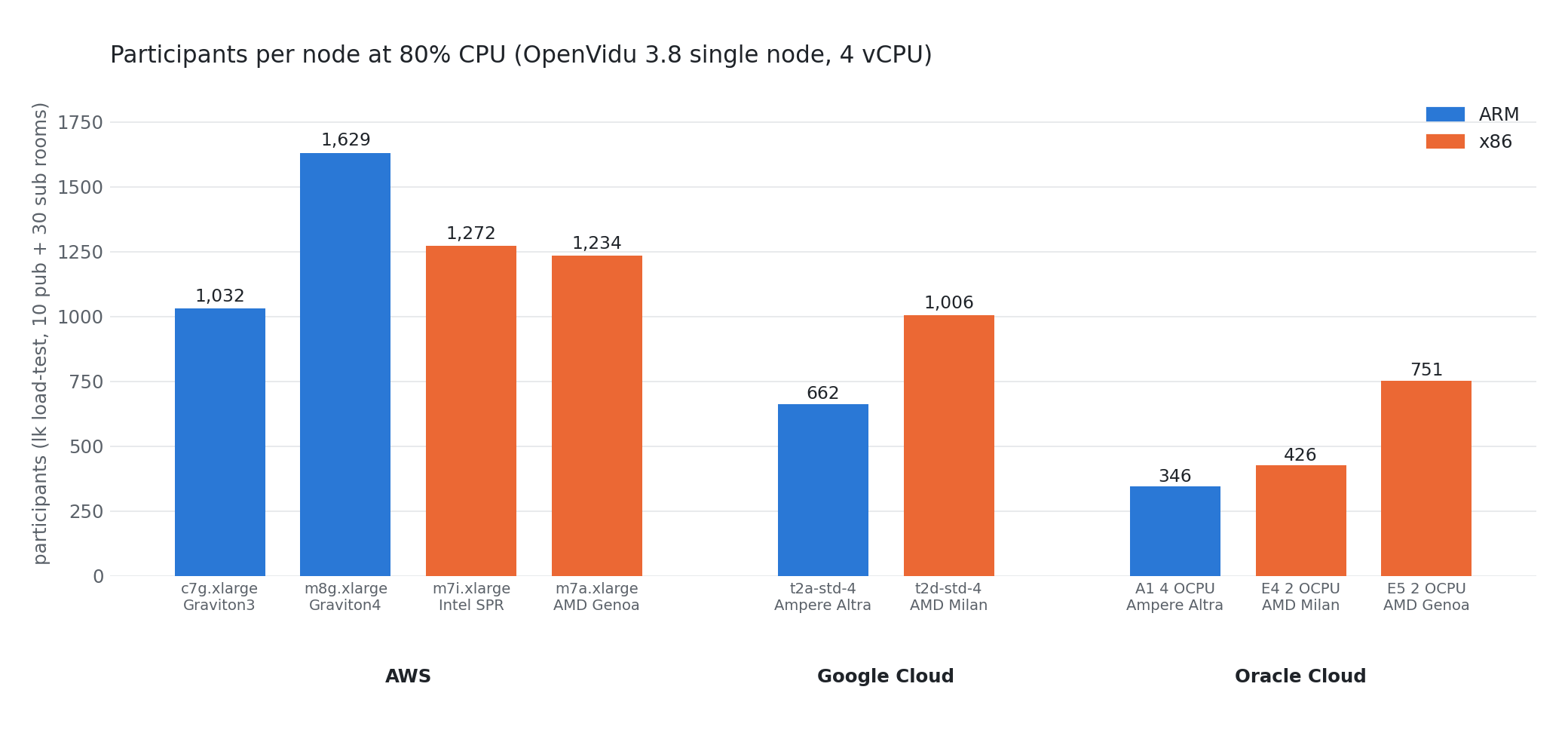
Participants per node at 80% CPU, ARM vs x86, on AWS, Google Cloud and Oracle Cloud Participants per node at 80% CPU, ARM vs x86, on AWS, Google Cloud and Oracle Cloud

On every major cloud, an ARM instance costs less per hour than the x86 instance of the same size. On AWS, for example, a 4-vCPU Graviton3 machine is about 20% cheaper than its Intel equivalent. But a lower price only saves money if the machine can handle a similar load, and for a WebRTC media server that means forwarding a similar number of RTP packets per second.

We didn't find any published numbers for SFU workloads on ARM, so we ran the test ourselves. We deployed the same OpenVidu 3.8 single node on matching ARM and x86 instances in AWS, Google Cloud and Oracle Cloud, and used the same load generator and ramp on all of them, adding participants until the CPU ran out.